
.avif)
.avif)
Your EAP utilization is sitting at 3%. Employees say they can't get appointments. And leadership wants to see ROI on every benefits dollar spent.
If this sounds familiar, you're not alone. Traditional EAPs rarely deliver the impact HR leaders need or the outcomes employees deserve. But making the case for an enhanced EAPcan feel like an uphill battle, especially when budget conversations are already tight.
Here's the truth: Enhanced EAPs may require a larger upfront investment and an increase in your EAP budget, but the right mental health solution drives higher utilization, measurable ROI, and better care for your people. The key is knowing how to translate that value into language your CFO and executive team will understand.
Let’s walk you through how to assess your current mental health benefits, define what success looks like, and make a data-backed pitch that connects employee wellbeing to business outcomes.
Assess where you are today
Before you can make the case for change, you need a clear picture of your current reality. Most organizations fall somewhere along a mental health benefits maturity curve—from reactive, compliance-driven programs to proactive, data-enabled solutions.
The four stages of mental health benefits maturity:
- Checking the box: You offer a traditional EAP that meets compliance requirements, but engagement is low, wait times are long, and there's no way to measure impact.
- Building: You've added digital tools or expanded your EAP, but provider quality and outcomes remain unclear.
- Developing: You're using evidence-based solutions with some tracking of outcomes and better crisis response.
- Leading: You've implemented a precision mental health platform with real-time ROI tracking, personalized care, and proactive engagement.
To figure out where you stand, look at your data:
- What's your current EAP utilization rate? Traditional programs average just 2–5%.
- How long do employees wait for appointments? The median wait time for an in-person behavioral health appointment is 67 days.
- Can you track clinical outcomes or ROI? If not, you're likely leaving value on the table.
- What does employee feedback say? Are they aware of the benefit? Do they trust it?
If your answers reveal long wait times, low engagement, or invisible outcomes, you're likely stuck in the "checking the box" stage. That's not a failure—it's a starting point.
Define what success looks like
Once you know where you are, the next step is to clarify where you want to go. What does a successful mental health benefit look like for your organization?
Start by identifying the KPIs that matter most to your business. These might include:
- Utilization rates: Aim for 10–25% or higher with a modern solution.
- Time to first appointment: Within a day or two is now the benchmark.
- Clinical improvement: Track symptom reduction using validated tools.
- Cost savings: Measure reductions in medical claims, absenteeism, and turnover.
- Employee satisfaction: Use pulse surveys or engagement data.
Next, benchmark yourself against peers. If your EAP utilization is 3% and industry leaders are seeing 20%+, that gap represents real opportunity for your employees and your bottom line.
Gather evidence that proves the status quo isn't working
Now comes the hard part: Making the case that your current solution is costing you more than you think.
This isn't about blaming your existing vendor or admitting failure. It's about showing that low engagement and unmeasured outcomes create invisible costs that add up fast.
Here's what those costs look like:
- Higher medical claims: Untreated mental health conditions lead to more ER visits, hospital stays, and chronic disease progression. Physical health costs drop by 14% when employees have access to quality mental health care.
- Increased absenteeism and disability claims: Employees who can't access timely support are more likely to take extended leave or file for short-term disability.
- Turnover: Replacing an employee costs 50–200% of their salary. Mental health challenges are a leading cause of voluntary attrition.
- Lost productivity: Even when employees show up, untreated anxiety or depression can reduce their ability to focus, collaborate, and perform.
When you add it all up, doing nothing is expensive. Staying with a low-engagement, low-impact EAP means you're spending money without results.
Show how enhanced EAPs deliver measurable ROI
This is where the conversation shifts from problem to solution. Enhanced EAPs aren't just better for employees—they're better for the business.
Here's what sets them apart:
- Fast access: Appointments in less than 24 hours.
- Personalized care: Employees are matched to providers based on their needs, preferences, and identity—not just who's available.
- Measurement-based care: Outcomes are tracked in real time, so you know what's working and what isn't.
- Proactive navigation: Care teams help employees find the right support before a crisis happens.
The results speak for themselves. Organizations that switch to enhanced EAPs see:
- 600% increase in utilization compared to their previous programs.
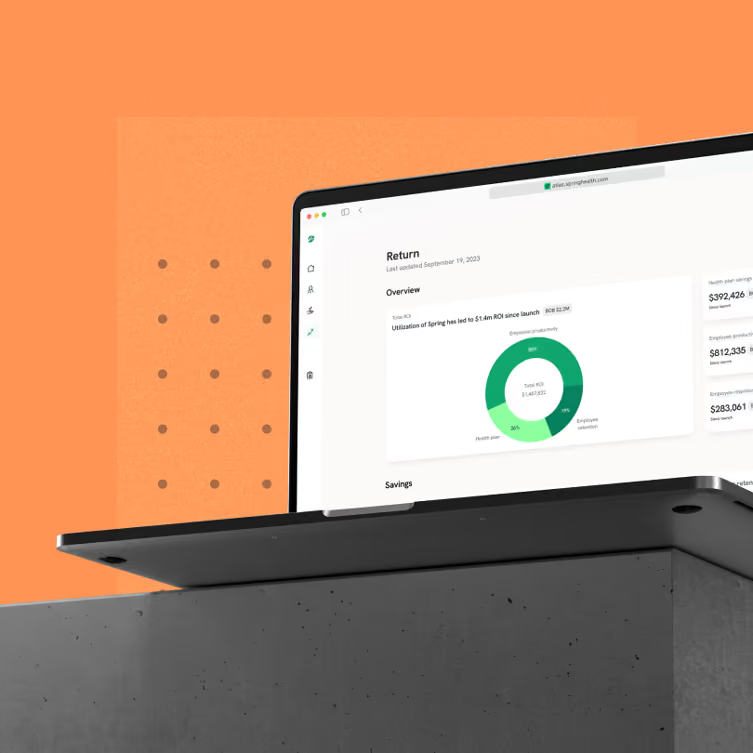
- 1.9x ROI in year one, growing to 2.4x cumulatively. Some customers achieve returns up to 4:1.
- $1,070 in average net savings per participant in the first year alone.
- 14% reduction in physical health costs, driven by fewer ER visits and hospitalizations.
These aren't theoretical benefits. They're validated outcomes backed by independent research and real customer data.
Connect mental health to business outcomes your CFO cares about
When you're ready to pitch, frame the conversation around financial impact, risk reduction, and business performance.
Here's a framework (and suggested talking points) to help guide that conversation:
1. Open with today's reality
"Our current EAP has a 3% utilization rate, and we have no way to measure outcomes or ROI. That means we're spending money on a benefit most employees don't use—and we can't prove it's helping the ones who do."
2. Address the cost concern
"Moving to a more effective solution will require additional budget. But staying with a low-engagement, low-impact option means we'll keep spending without results. The real question is: Can we afford not to invest in something that works?"
3. Highlight the predictable payoff
"With a data-driven mental health platform, we can predict and track health plan cost savings. Research shows that for every $1 invested, organizations see up to $3 in return—through lower turnover, reduced absenteeism, and fewer high-cost medical claims."
4. Show the people and business impact
"Mental health directly affects retention, productivity, and engagement. When employees can't access timely care, we see higher turnover, more disability claims, and lost productivity. This solution helps us reduce those costs while building a healthier, more resilient workforce."
Quantify the value beyond health plan savings
ROI isn't just about reducing medical claims. Enhanced EAPs deliver value across the business in ways that matter to every executive at the table.
- Higher employee engagement: When people feel supported, they're more likely to stay, contribute, and recommend your company to others.
- Productivity gains: Early mental health support helps employees stay focused and effective, reducing presenteeism and lost work time.
- Talent attraction and retention: In a competitive labor market, comprehensive mental health benefits are a differentiator that helps you attract and keep top talent.
- Workplace incident reduction: Better mental health support reduces the risk of workplace conflicts, safety incidents, and HR escalations.
- Improved clinical outcomes: Personalized, evidence-based care leads to faster recovery and long-term wellbeing.
When you add these factors to direct cost savings, the business case becomes even stronger.
Make it easy to say yes
The final step is to remove friction from the decision-making process. Address common concerns upfront and make it clear that implementation won't add to HR's workload.
Common objections and how to respond:
- "Implementation will take too much time." Dedicated teams handle setup, communications, and integrations, reducing HR's burden and ensuring a smooth rollout.
- "Our employees won't use it." Fast access, personalized matching, and stigma-free design drive engagement rates 600% higher than traditional EAPs.
- "We don't have budget this cycle." Many customers reallocate underperforming EAP or wellness spend. The ROI justifies the shift.
- "It's too expensive." Independent validation shows for every dollar spent, employers save nearly $2 in health plan costs, providing $1,070 in net savings per participant in the first year. The cost offsets through lower turnover and health plan spend.
Moving from support to strategic advantage
Enhanced EAPs aren't just a benefit. They're a lever for cost control, talent retention, and workforce resilience. When you can show that investing in mental health delivers measurable business outcomes, the conversation shifts from "Can we afford this?" to "Can we afford not to?"
Start by assessing where you are today, defining what success looks like, and gathering the evidence you need to make a compelling case. With the right data and the right framing, you can build a business case that resonates with your CFO, supports your employees, and moves your organization up the maturity curve.




.png)


.avif)
.avif)


.avif)

.avif)
.avif)
