


The best HR metrics to track are not just data points. They are reflections of your employees' daily experiences. Understanding this connection is crucial. When burnout, stress, and anxiety are widespread, your most important metrics will trend in the wrong direction.
Conversely, when you proactively support your people’s mental health, you create the conditions for them to thrive, which in turn drives positive business outcomes. This post will walk through 10 essential HR metrics, exploring how mental health influences each one and how a modern mental health strategy can help you move these numbers forward.
10 of the best HR metrics to track and how mental health impacts them
Each of these metrics tells a story. When you look closely, you’ll find that employee mental health is a central character in every one. Let's explore the cause-and-effect relationship between mental wellbeing and your organization's most important people analytics.
1. Regrettable attrition rate
- What it measures: Paylocity defines regrettable (or regretted) attrition as “the voluntary exit of valued employees, often in response to factors the organization could change.”
- Why it matters: High turnover is expensive, costing an estimated one-half to two times an employee's annual salary. And when valued employees leave, often for preventable reasons, the cost can be even higher. It also damages team morale, disrupts projects, and leads to knowledge loss.
- How mental health affects it: Burnout is a leading driver of turnover. Employees experiencing chronic stress, anxiety, or depression are more likely to seek new opportunities in search of a healthier environment. A workplace that stigmatizes mental health or lacks adequate support will see its best talent walk out the door.
- What leading organizations do differently: They invest in proactive mental health support, training managers to spot signs of employee burnout and have supportive conversations. They also provide easy, confidential access to high-quality therapy and coaching, helping employees build resilience before they reach a breaking point.
2. Absenteeism rate
- What it measures: The rate of unplanned employee absences due to illness or personal issues.
- Why it matters: High absenteeism disrupts workflows, burdens other team members, and results in significant productivity losses. It’s often a clear indicator of underlying health and morale issues.
- How mental health affects it: Mental health conditions like depression and anxiety are major contributors to absenteeism. Employees may need to take time off to manage their symptoms, attend appointments, or simply cope with overwhelming stress. Fear of stigma can also lead them to use generic sick days rather than explain the real reason for their absence.
- What leading organizations do differently: They create a culture where taking a mental health day is accepted and destigmatized. They also offer fast access to care, which can help employees address issues sooner and reduce the need for extended time off.
3. Unplanned leave of absence (LOA) & disability rates
- What it measures: The frequency, duration, and cost of employees taking short-term or long-term leaves of absence beyond planned reasons, such as paternity/maternity leave. LOAs for mental health reasons are one example of unplanned LOAs.
- Why it matters: LOA and disability are costly due to both direct expenses (like insurance premiums) and indirect costs (like lost productivity and backfilling roles). Mental health is a leading driver of these claims.
- How mental health affects it: When an employee’s mental health becomes unmanageable, a leave of absence is often the only option. Proactive support can prevent many situations from escalating to this point.
- What leading organizations do differently: They focus on prevention and early intervention. By offering immediate access to therapy, medication management, and other support, they help employees address mental health challenges before they become severe enough to require a leave.
Kelsey Witmer and Karishma Patel Buford, who are two of Spring Health's HR leaders, discuss below what's driving the increase in mental health leaves at work. For the full conversation, sign up for Rooted on demand.
4. Quality of hire
- What it measures: Whether new hires become productive quickly, perform well early, and are likely to succeed long-term. Often measured with a 90-day manager survey plus early performance/attrition signals.
- Why it matters: A bad hire is a costly mistake. Quality of hire helps shift recruiting conversations from speed to long-term value and reduces downstream costs tied to early exits and re-hiring.
- How mental health affects it: Onboarding is a high-stress window. When expectations are unclear or support is hard to access, early friction can turn into disengagement and early attrition.
- What leading organizations do differently: They keep it simple: run a 90-day manager survey, track 90/180-day attrition, and review patterns monthly (by role/team/manager) to improve hiring and onboarding.
5. Employee engagement (and the drivers that actually move it)
- What it measures: How connected employees feel to their work and organization, typically captured through engagement surveys or eNPS. But the most useful view isn’t the headline score; it’s the drivers underneath it (especially items tied to manager support, role clarity, resources, and psychological safety).
- Why it matters: Engagement is often an early signal for retention, performance, and customer outcomes. When engagement drops, particularly in specific teams or under specific managers, it can show where risk is building before it becomes turnover, absenteeism, or LOAs. The key is to break results down by team/manager/role, not just look at company-wide averages.
- How mental health affects it: Chronic stress and burnout reduce an employee’s capacity to stay connected, collaborate, and problem-solve. When people are overwhelmed — or don’t feel safe raising issues — “discretionary effort” disappears first. Over time, detachment becomes attrition risk.
- What leading organizations do differently: They treat engagement as an operating metric, not an HR vanity score. They:
- Prioritize a small set of drivers that predict outcomes (e.g., “My manager supports me,” “I have what I need to do my job,” “I can raise concerns without fear,” “My workload is sustainable.”)
- Track those drivers by team and manager to spot hotspots early.
- Pair measurement with action: Manager enablement, workload resets, clearer expectations, and easier access to meaningful support so challenges don’t escalate into leave or turnover.
6. Total healthcare & benefits costs
- What it measures: Your organization’s total spending on employee health benefits, including medical, pharmacy, and mental health programs.
- Why it matters: Rising healthcare costs are a major concern for nearly every employer. Controlling this spend without compromising care quality is a top priority for HR and finance leaders.
- How mental health affects it: Untreated mental health conditions have a significant impact on physical health, leading to higher medical and pharmacy claims. Conditions like diabetes, heart disease, and chronic pain are often exacerbated by stress, depression, or anxiety. This results in more doctor visits, prescriptions, and higher overall costs.
- What leading organizations do differently: They invest in comprehensive mental healthcare that is proven to improve outcomes and lower total cost of care. By providing fast access to effective treatment, they help employees manage their mental health that’s proven to deliver ROI by reducing healthcare costs.
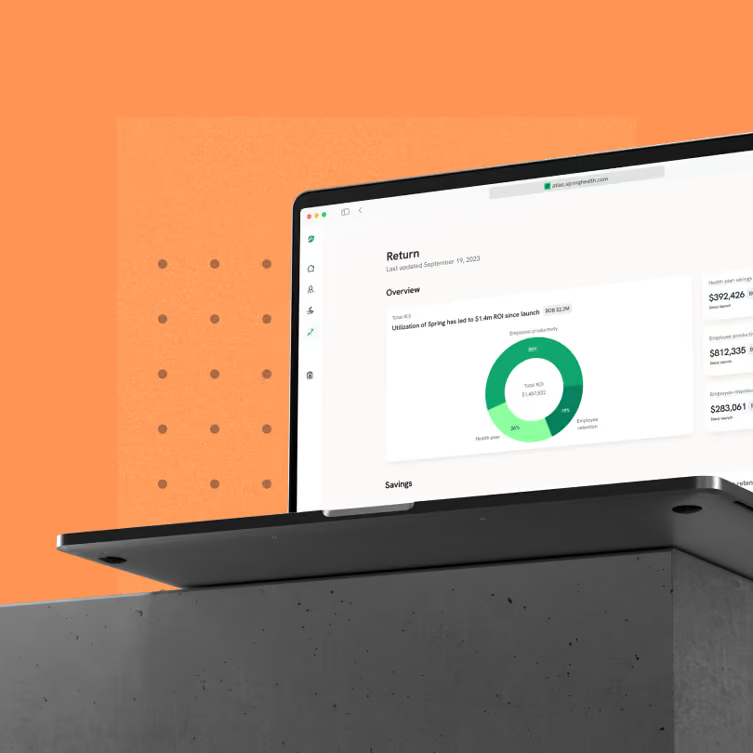
Mental health utilization is a key driver in containing employer healthcare costs, which is how organizations truly experience mental health ROI. Watch below as Casey Smolka, Lead Product Manager, Data Products at Spring Health, breaks it down.
7. Time to productivity
- What it measures: The time it takes for a new hire—or an employee returning from leave—to become fully proficient in their role.
- Why it matters: A long ramp-up period is a drain on resources. The faster an employee can contribute at full capacity, the quicker you see a return on your hiring and training investment.
- How mental health affects it: New roles can be stressful, and returning to work after a leave can be daunting. Employees struggling with social anxiety or a lack of confidence may take longer to integrate and perform. A supportive environment helps ease this transition.
- What leading organizations do differently: They build mental health support directly into their onboarding and return-to-work programs. This includes manager check-ins, access to coaching, and clear communication about available resources, ensuring employees feel supported from day one.
8. Manager effectiveness scores
- What it measures: How employees rate their managers on factors like support, communication, development, and fairness.
- Why it matters: Managers have a direct impact on nearly every other metric on this list, from engagement to retention. An effective manager is a force multiplier for positive outcomes.
- How mental health affects it: Employees won't feel safe approaching managers who don’t feel confident and equipped to support them. Furthermore, managers are also at high risk for burnout themselves, which degrades their ability to lead effectively.
- What leading organizations do differently: They train managers on how to recognize signs of distress, initiate compassionate conversations, and connect employees with professional help. They also provide dedicated mental health support for leaders, recognizing that they cannot pour from an empty cup.
9. Mental health/EAP utilization
- What it measures: The percentage of your eligible population that uses the mental health benefits you offer, including traditional Employee Assistance Programs (EAPs).
- Why it matters: Low utilization doesn't mean your employees are healthy; it often means your solution is coming up short. Barriers like long wait times, poor provider quality, or stigma prevent people from getting help.
- How mental health affects it: This metric directly reflects the accessibility and effectiveness of your mental health strategy. High utilization of a high-quality program indicates that employees trust the benefit and are actively seeking support, which is a leading indicator of a healthier workforce.
- What leading organizations do differently: They move beyond check-the-box EAPs and invest in modern solutions with digital-first access, robust provider networks, and personalized care navigation. They communicate about these benefits regularly, normalizing help-seeking behavior.
10. Internal mobility rate
- What it measures: How often employees move into new roles internally, including promotions (vertical) and lateral moves (horizontal).
- Why it matters: Mobility is a strong retention and continuity lever. It lowers replacement costs, speeds ramp time versus external hires, and signals healthy career pathways.
- How mental health affects it: Growth requires bandwidth. In distressed teams, people are less likely to pursue new opportunities and more likely to disengage or leave.
- What leading organizations do differently: They track mobility by team/manager, remove “talent hoarding,” and connect mobility trends to leading indicators like thriving and manager support so they can unblock growth before it becomes attrition.
From insight to action: How HR can use these metrics
Tracking these data points is only the first step. The real value comes from turning those insights into action. Here is a practical playbook for using people analytics to drive a powerful mental health strategy.
- Create a unified dashboard: Consolidate these metrics in one place to get a holistic view of workforce health. Avoid looking at any single metric in isolation.
- Segment your data: Analyze your metrics by business unit, manager, geography, and role. This will help you identify hotspots and patterns. Are turnover and absenteeism highest in one specific department? Is burnout risk concentrated among certain roles?
- Overlay mental health data: Compare your HR metrics against mental health benefit utilization and burnout risk assessments. Look for correlations. For example, do teams with low psychological safety scores also have high absenteeism? The right mental health solution can help you improve tracking.
- Invest in solutions with measurable outcomes: Partner with a mental health provider that can deliver clear, quantifiable results. Look for partners who report on clinical outcomes (like a reduction in depression or anxiety symptoms) and can demonstrate a tangible return on investment.
- Make managers your force multiplier: Equip your people leaders to be agents of change. Provide them with practical training on promoting wellbeing, playbooks for difficult conversations, and—critically—access to mental health support for themselves.
Don’t just track metrics. Transform what drives them.
Your HR metrics are more than just numbers on a spreadsheet; they are stories about how your people are doing. When mental health is overlooked, those stories often involve rising costs, lost productivity, and a constant cycle of firefighting. But when you prioritize and strategically support your employees' mental wellbeing, a different story emerges.
The same metrics that once signaled problems become proof of impact. They show that HR is not just a cost center but a strategic driver of business outcomes. They demonstrate that investing in people is the most effective way to build a resilient, engaged, and high-performing organization.
If you want to see how a modern mental health strategy can move your most important HR metrics—turnover, absenteeism, healthcare costs, and more—connect with our team to explore what’s possible for your organization.




.png)


.avif)
.avif)


.avif)

.avif)
.avif)
