


As an HR or benefits leader, you are at the center of a complex challenge. Employee burnout, stress, and mental health needs are rising, while the C-suite rightfully demands clear value and a return on investment for every dollar spent. So many solutions claim to offer "innovative mental health solutions," making it difficult to separate genuine progress from a slick app or a repackaged EAP.
The importance of getting this right has never been higher. True innovation isn't about features for their own sake; it's about delivering solutions that measurably improve access, clinical outcomes, and business impact.
Unlike traditional EAPs, which are often characterized by low utilization, limited support, and no credible ROI, truly innovative mental health solutions move the needle for your people and your business.
Start with outcomes, not features
The first test of any innovative solution is whether the solution can prove that it works. Utilization should be considered table stakes; the real differentiator lies in measurable outcomes. Many legacy solutions, such as traditional EAPs, focus on vanity metrics like logins or content views, but they can't demonstrate that employees are actually getting better.
In contrast, a truly innovative mental health solution is built on a foundation of measurement-based care. This means using validated clinical assessments—not just intake forms—to track progress regularly. Look for solutions that provide clear, specific reporting on:
- Clinical outcomes: Evidence of symptom reduction, recovery rates, and how quickly members show improvement.
- Meaningful engagement: Utilization that reflects actual care engagement and drives ROI.
- Speed to care: Transparent data on the average time-to-first-appointment.
- Business impact: Independently validated ROI that demonstrates a tangible impact on total medical spend, disability claims, employee retention, and productivity.
Key questions for mental health solutions:
- How do you define and measure clinical improvement, and over what timeframe?
- What independent data or third-party validation can you provide on clinical outcomes and total cost of care?
- Can you show us recovery rates for members with moderate to severe anxiety or depression?
- What is your average time from a member’s initial request to their first appointment with a provider?
Look for precision, not just point solutions
An employee's needs exist on a wide spectrum, from everyday stress and burnout to anxiety, depression, substance use disorders, and high-acuity crises. A collection of disconnected point solutions—a meditation app here, a therapy bank there—cannot effectively manage this complexity.
Precision is about getting the right person to the right level of care at the right time. This is where you can see mental health innovation in the workplace really shine. Innovative employee mental health solutions use smart, evidence-based methods to accurately assess a person’s needs and guide them to the most effective support, whether that's:
- Self-guided digital tools
- Mental health coaching
- Therapy
- Medication management
- Specialty care
- Crisis support
This precision care model should guarantee fast access (days, not weeks or months) and provide clear pathways for escalating needs, including crisis intervention and specialty programs for issues like substance use or trauma. It also extends beyond the individual to support managers and leaders with training and resources to foster psychologically safe environments.
For employers, this early and precise intervention is critical. It reduces the likelihood of issues escalating to require emergency care, hospitalizations, or costly, unmanaged chronic conditions.
Key questions for mental health solutions:
- Can you walk us through your process for triaging members and routing them to the appropriate care path?
- What is the breakdown of your care delivery (e.g., self-guided, coaching, therapy, specialty care)?
- How quickly can a member identified as high-risk be seen by a qualified clinician?
- What resources and training do you provide for managers and people leaders?
Insist on innovation that’s safe, ethical, and human
AI is becoming a common component of many innovative mental health solutions, and for good reason. However, HR leaders are right to be cautious. The use of AI in mental health raises valid concerns about safety, privacy, and regulatory compliance. Employees need to feel supported, not surveilled.
A responsible and innovative partner will be transparent about how they use technology. They should be able to demonstrate a commitment to safety and ethics that puts the member first.
An AI due diligence checklist for innovative mental health solutions
When evaluating a vendor that uses AI, ask for proof of:
- A clear AI governance framework: They should have documented policies and procedures for the ethical development and deployment of their AI models.
- Human expert oversight: Critical decisions, especially those related to risk assessment and crisis response, must involve qualified clinicians.
- HIPAA-compliant, privacy-first design: Ensure their infrastructure is secure and designed to protect sensitive personal health information.
- Transparency for members: They should use member-friendly language to explain where AI is used and how data flows.
- Data protection policies: Get explicit confirmation that member data is never used to train public AI models and is not shared with employers at an individual level.
Choose innovation that addresses culture, burnout, and equity
Individual treatment is essential, but it’s only half the battle. Forward-thinking solutions recognize that the workplace environment itself plays a major role in employee wellbeing. True mental health innovation in the workplace must also help you address systemic issues.
Employee burnout isn’t a personal failing—it’s a systemic issue that requires organizational change. Factors like excessive workload, lack of control, and poor social support contribute significantly to employee distress. Similarly, top stressors often stem from financial worries, caregiving responsibilities, and work-life conflict.
Innovative mental health benefits address this by offering:
- Systemic support: Programs and resources focused on burnout prevention and organizational resilience, not just individual crisis response.
- Leadership enablement: Training for managers and leaders on how to create psychologically safe teams where employees feel supported.
- Stigma reduction: Thoughtful communication campaigns that normalize seeking help and make it obvious where employees should go to get started.
- Built-in mental health equity: A commitment to inclusive care, including diverse provider networks, multilingual support, culturally informed care practices, and global capabilities where needed.
- Population-level insights: Anonymized analytics that help HR leaders understand risk factors, engagement trends, and areas of need across the organization.
Make ROI and cost containment part of your definition of “innovative”
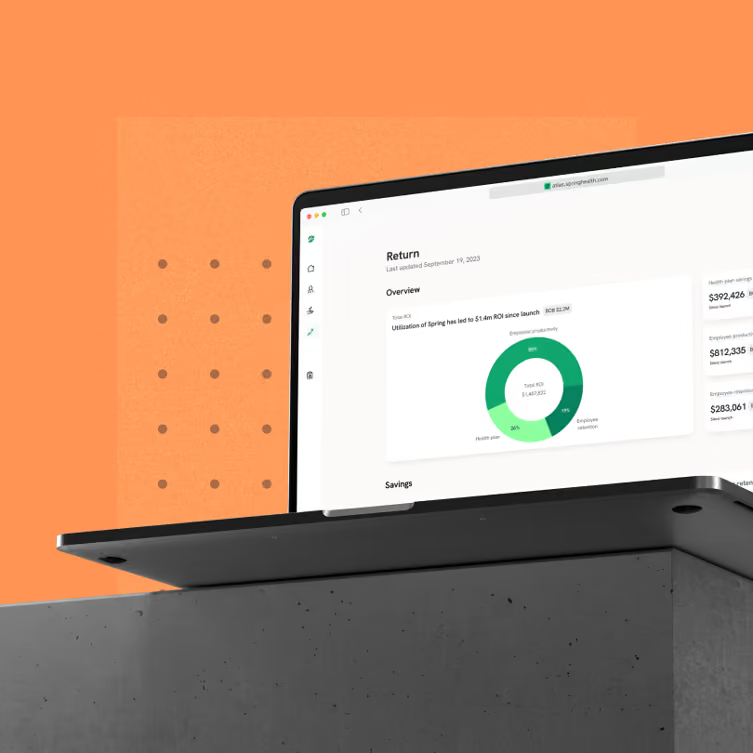
A mental health solution must be able demonstrate its value in a room with your CFO. The connection between mental health and your organization's bottom line is clear and direct, impacting everything from medical claims to productivity.
Poor mental health can be a hidden but major driver of comorbidities, emergency room visits, hospitalizations, disability leaves, and employee turnover. An innovative solution should be able to prove its ability to contain these costs.
Watch below as Casey Smolka, Lead Product Manager, Data Products at Spring Health, discusses the importance of utilization in driving down high-cost claims.
Look for a solution that can demonstrate financial impact by:
- Reducing overall medical and pharmacy spend.
- Improving health outcomes for employees with chronic physical conditions.
- Lowering rates of absenteeism, disability, and turnover.
- Boosting productivity and engagement.
When discussing mental health ROI:
- Challenge solutions to be transparent.
- Ask for their ROI methodology.
- Differentiate between hard savings (verifiable reductions in claims, ER visits, and leave costs) and soft savings (estimated gains in productivity and engagement).
A credible solution will be able to speak to multi-year impact, not just a one-time effect.
For your organization to innovate, you need an innovative solution
Innovative mental health solutions are the ones that move the needle, for your people and your business. As you evaluate your options, don't settle for partners who can't provide clear evidence of their impact across:
- Clinical outcomes
- Employee experience
- Financial returns
If you’re evaluating modern employee mental health solutions now, consider partnering with vendors who can show independently validated outcomes and ROI, a full-spectrum care model, and a clear AI safety framework.
By focusing on these core pillars of innovation, you can confidently select a solution that delivers lasting value to both your employees and your organization.




.png)


.avif)
.avif)


.avif)

.avif)
.avif)
