




Blog highlights
- Spring Health is a mental health platform, not an EAP. It can replace a traditional EAP while delivering broader clinical support and measurement.
- Traditional EAPs often measure utilization. Spring Health measures outcomes, including 92% of members reliably improved or recovered from depression or anxiety.
- Provider appointments are available in less than a day, versus a 48-day average with traditional EAPs.
- Spring Health is the first mental health solution to guarantee net ROI, and every single customer has achieved it.
Spring Health vs. traditional EAP: Why the EAP status quo isn’t enough
In today’s workplace, where employee burnout persists and healthcare costs are rising, traditional employee assistance program (EAPs) are no longer enough. Traditional EAP utilization remains staggeringly low, access is slow, and results are hard to measure.
Spring Health is a global mental health company built on one AI-native platform. For employers, that means care can move beyond utilization reports and limited-session models toward faster access, clinically guided support, real-time visibility, and outcomes your team can defend to finance.
Is Spring Health an EAP?
Spring Health is a mental health platform, not an EAP. For employers evaluating EAP alternatives, Spring Health can deliver the required support areas buyers expect from an EAP, while adding fast access to care, clinical measurement, specialty care pathways, reporting, and validated ROI.
That distinction matters. Traditional EAPs were built to offer confidential short-term support and referrals. That can be useful, but the model often stops at activity: calls, sessions, and utilization. Employers now need to know whether care is timely, whether employees improve, and whether the benefit reduces avoidable cost.
| Feature | Traditional EAPs | Spring Health |
|---|---|---|
| Category | Short-term workplace support benefit | AI-native mental health platform |
| Access | Wait times can stretch for weeks | < 1 day |
| Measurement | Often centered on utilization | Clinical outcomes, engagement, and financial impact |
| Care model | Episodic support and referrals | Care matched to each member's needs |
| ROI | Often difficult to prove | Net ROI guaranteed, with every customer achieving it |
| Clinical proof | Often limited or hard to validate | 92% of members reliably improved or recovered from depression or anxiety |
| Competitive difference | Measures activity | Measures outcomes |
For a benefits leader, the practical question is simple: can the vendor show that people got better, care happened quickly, and the investment paid for itself?
Why traditional EAPs fall short for today’s workforce
Traditional EAPs were built with good intentions. They gave employees a confidential place to ask for help and gave employers a way to offer support. The problem is that many programs still operate as episodic benefits: An employee reaches out, receives a limited number of sessions or referrals, and then the experience often resets.
That structure does not match how mental health works. Employees may need coaching, therapy, medication management, crisis support, substance use disorder support, or specialty care. Needs change over time. A benefit that only responds to a narrow moment can miss what happens before and after that moment.
This is where the comparison shifts. Spring Health does not try to be a better version of the traditional EAP model. Spring Health is a lifelong mental health platform designed to help care follow people as their needs, providers, jobs, and life circumstances change.
Outcomes matter more than utilization
Utilization can tell you whether people touched the benefit. It cannot tell you whether they improved.
Spring Health is built around measurement-based care. Members complete clinically validated assessments, receive a personalized care plan, and are matched to care based on their needs. Progress is tracked over time, so care can adjust when someone is not improving.
That model produces measurable results. In the largest outcomes study of its kind, 92% of Spring Health members reliably improved or recovered from depression or anxiety, and 62% achieved remission. Members also recover 5.9 weeks faster than Spring Health’s leading competitor.
For HR and benefits teams, this creates a stronger internal story. The benefit is not only being used. It is helping people get better.
Speed to care changes the employee experience
When an employee decides to seek care, timing matters. A long wait can turn one moment of readiness into another barrier.
Spring Health offers provider appointments in less than a day, compared with a 48-day average with traditional EAPs. That speed is not only operational. It changes how employees experience the benefit. They do not have to navigate a generic directory, wait weeks, or start over after reaching the wrong level of care.
Fast access also supports the business case. Earlier care can reduce the risk that untreated needs become more complex, more expensive, or more disruptive to work and life.
AI-native architecture makes the difference durable
AI is easy to add as a feature. It is much harder to build care around it from the start.
Spring Health was founded in 2016 as an AI company. That matters because AI-native architecture is the foundation for precision matching, Guide, reporting, and ongoing support across the care journey. We are AI-native, not AI-enabled. AI is the foundation, not a feature we bolted on.
For employers, this translates into a more adaptive benefit. Members can be matched to the right care faster. Employers can see outcomes more clearly. The platform can support care that builds instead of resets.
ROI has to be provable
| Metric | Result | Source |
|---|---|---|
| Net Savings (Year One) | $1,070 per participant | JAMA Network Open |
| ROI Guarantee | $1.10 saved for every $1 invested | Validation Institute |
| Cumulative ROI (Year 3) | 2.4x ROI | Validation Institute |
| Reduction in Mental and Physical Health Claims Costs | 24% | JAMA Network Open |
Mental health benefits now sit inside a larger cost conversation. CHROs and benefits leaders need to support employees while proving the investment to the CFO.
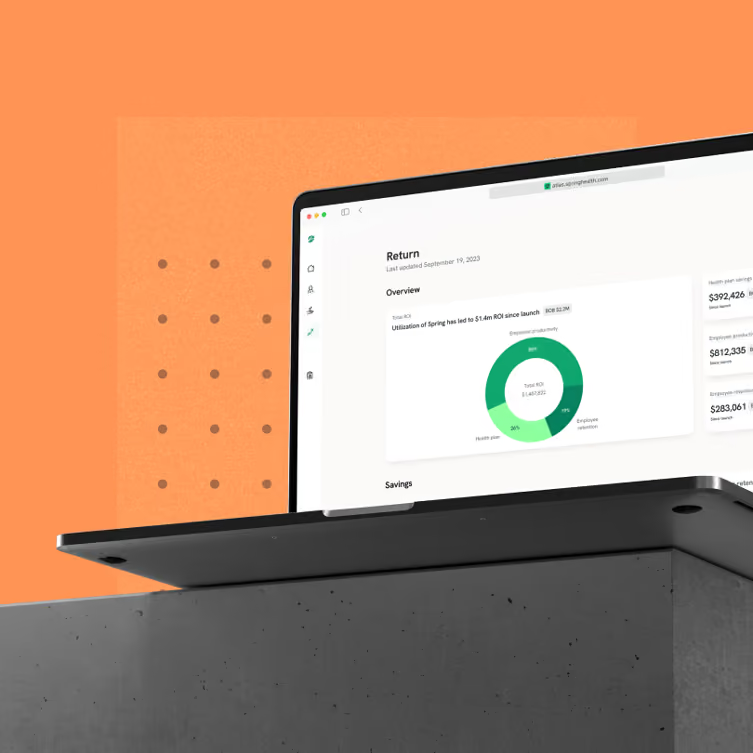
Spring Health is the first mental health solution to guarantee net ROI, and every single customer has achieved it. Employers using Spring Health have also seen a 52% reduction in total mental health claims costs and a 24% reduction in total net mental health and physical claims costs.
That proof changes the renewal conversation. Instead of defending a benefit based on usage alone, HR leaders can point to independently validated clinical and financial outcomes.
What HR leaders should ask when comparing Spring Health and traditional EAPs
Use these questions when evaluating whether your current EAP is enough:
- Can the vendor report clinical outcomes, or only utilization?
- How quickly can employees access an appointment with the right provider?
- Does the model support employees beyond a limited-session episode?
- Can the vendor support higher-acuity needs and specialty care pathways?
- Does the vendor show financial impact using validated claims-cost data?
- Is the experience built on one platform, or does it rely on fragmented referrals?
- Can the vendor explain how AI improves care without relying on generic AI claims?
- Can the benefit support employees as their needs change over time?
The strongest mental health benefit should help employees find care quickly, stay engaged long enough to improve, and give employers proof that the investment works.
Choosing the right model for your workforce
The traditional EAP category helped normalize workplace mental health support. That was important. The next step is accountability.
Employers should expect more than access to a hotline, a referral list, or a utilization report. They should expect care that is fast, clinically guided, measurable, and built for the full arc of a person’s mental health.
Spring Health gives employers that model: one AI-native platform, fast access to care, published clinical outcomes, and validated ROI.
Talk to Spring Health to compare your current EAP against a mental health platform built for measurable outcomes.
See the Spring Health difference
Contain health costs. Provide a benefit that makes an impact.
FAQ
Is Spring Health an EAP?
Spring Health is a mental health platform, not an EAP. It can replace a traditional EAP while delivering broader support, including therapy, coaching, medication management, specialty care, crisis support, measurement-based care, and reporting for employers.
What is the biggest difference between Spring Health and a traditional EAP?
The biggest difference is measurement. Traditional EAPs often measure utilization, such as calls or sessions. Spring Health measures clinical outcomes and financial impact, including reliable improvement, remission, speed to care, claims-cost reduction, and net ROI.
How fast can employees access care with Spring Health?
Spring Health offers provider appointments in less than a day, compared with a 48-day average with traditional EAPs. Faster access helps employees begin care when they are ready, instead of waiting weeks for support.
How does Spring Health prove ROI?
Spring Health uses validated clinical and claims-cost outcomes to show financial impact. Spring Health is the first mental health solution to guarantee net ROI, and every single customer has achieved it.
Does Spring Health support higher-acuity needs?
Yes. Spring Health supports members across levels of need, including specialty care and crisis support. One-to-One Navigation helps members find the right care pathway and coordinates support when needs are more complex.
About Spring Health
Spring Health is a global mental health company built on one AI-native platform so care follows individuals across every job, move, health plan, and life stage. Independently validated by JAMA Network Open and the Validation Institute, Spring Health reaches 170+ million people worldwide through leading employers and health plans.




.png)


.avif)
.avif)

.avif)

.avif)
.avif)
