


Employer healthcare costs are rising again, and the 2026 numbers are forcing benefits leaders into a harder conversation than usual.
KFF reported that average annual premiums for employer-sponsored family health coverage reached $26,993 in 2025, up 6% from the year before. Business Group on Health projected a 9% median employer healthcare cost trend for 2026 before plan changes, and 7.6% after plan design changes.
That gap matters. Employers could be managing a variety of cost drivers, such as renewal pressure, employee affordability concerns, pharmacy spend, high-cost claims, or growing demand for mental health and substance use disorder care.
Mental health care is one of the few benefit areas that can affect multiple cost drivers at once: medical utilization, pharmacy adherence, leave, disability, productivity, chronic condition management, and high-cost claim risk.
Employer healthcare costs are rising again in 2026
The latest projections point in the same direction: Employers should expect another expensive year.
Mercer projected total health benefit cost per employee to rise 6.7% in 2026, pushing average cost above $18,500 per employee.
Those forecasts are not happening in isolation. They follow several years of elevated healthcare trend, missed forecasts, and affordability pressure for both employers and employees. For benefits leaders, that creates a difficult strategic tension:
- Absorb the increase and put more pressure on the business.
- Shift more cost to employees and risk lower access, lower trust, and delayed care.
- Reduce benefits and risk worse health outcomes or retention pressure.
- Invest in the areas most likely to reduce avoidable downstream spend.
The last option is where better mental and behavioral health deserves more attention.
What is driving employer healthcare costs higher?
Several cost drivers are compounding at the same time, including:
- Medical care utilization. The unit cost and utilization of healthcare services have increased. And that’s left employers seeking a way to contain these costs and ensure benefits are providing value.
- High-cost claimants. These types of claims can create unpredictability for self-funded employers and future premium pressure for fully insured employers.
- Pharmacy spend. Specialty drugs and GLP-1 medications continue to put pressure on pharmacy budgets.
- Cancer and chronic conditions. Cancer remains a major employer cost driver, while chronic conditions continue to account for a large share of U.S. healthcare spending.
- Mental health and substance use disorder needs. Business Group on Health reports that 73% of employers have seen an increase in mental health and substance use disorder services.
That last point is often treated as a separate benefits issue. It should not be. Mental health needs can raise direct spend through higher behavioral health costs, but the larger financial impact often shows up elsewhere, such as repeated medical visits, poor chronic condition management, emergency care, disability, leave, absenteeism, and reduced productivity.
Why behavioral health costs belong in the healthcare cost conversation
Behavioral health costs belong in the healthcare cost conversation because untreated or undertreated mental health needs often increase the use of other medical services. For employers, mental health care should be a cost-containment strategy that can reduce avoidable spend across the broader health plan.
This is especially important because many of the biggest cost drivers are not purely physical.
An employee managing cancer treatment may also be coping with anxiety, sleep disruption, financial strain, and caregiver stress. An employee with chronic pain may also be navigating depression, isolation, or unsafe medication use. Someone taking a GLP-1 may need support with body image distress, disordered eating risk, stigma, or behavior change.
Mental health care does not replace medical care. It helps people stay engaged in appropriate care, manage stress, follow treatment plans, and get support before distress turns into a more expensive health event.
Mental health utilization is a key driver in containing employer healthcare costs, which is how organizations truly experience mental health ROI. Watch below as Casey Smolka, Lead Product Manager, Data Products at Spring Health, breaks it down.
How better mental health care helps contain healthcare spend
A mental health benefit can support cost containment when it does three things well: gets people into care quickly and efficiently, matches them to the right type of care, and measures whether care is working.
1. Faster access can reduce avoidable escalation
When employees cannot get timely mental health support, they often wait until the problem becomes urgent. That can mean emergency department visits, inpatient stays, medical visits that do not resolve the root issue, or time away from work.
Fast access changes the trajectory. With Spring Health, there’s less than two days average time to first appointment. That speed matters because early care can help people stabilize before symptoms worsen or spill into other parts of the health plan.
2. The right care match reduces trial and error
Mental healthcare often fails when people are sent to care that does not fit their needs, preferences, culture, schedule, acuity, or condition. Trial and error wastes time, discourages employees, and can lead people to drop out before care works.
Spring Health’s Precision Mental Healthcare approach is designed to match each person to the provider and care approach most likely to help them. That means therapy, coaching, medication management, self-guided tools, crisis support, or specialty programs can be used based on the member’s needs, not a generic pathway.
3. Measurement shows whether the benefit is working
Utilization alone is not enough. A program can drive appointments and still fail to improve outcomes.
Employers need to know whether employees are improving, recovering, and avoiding higher-cost care. Spring Health is independently validated by JAMA Network Open and the Validation Institute. These outcomes include:
- 92% of members reliably improved or recovered from depression or anxiety.
- Members recover 5.9 weeks faster than our leading competitor.
- Employers see a 52% reduction in total mental health claims costs.
- Patients’ healthcare costs are $1,796 lower per year.
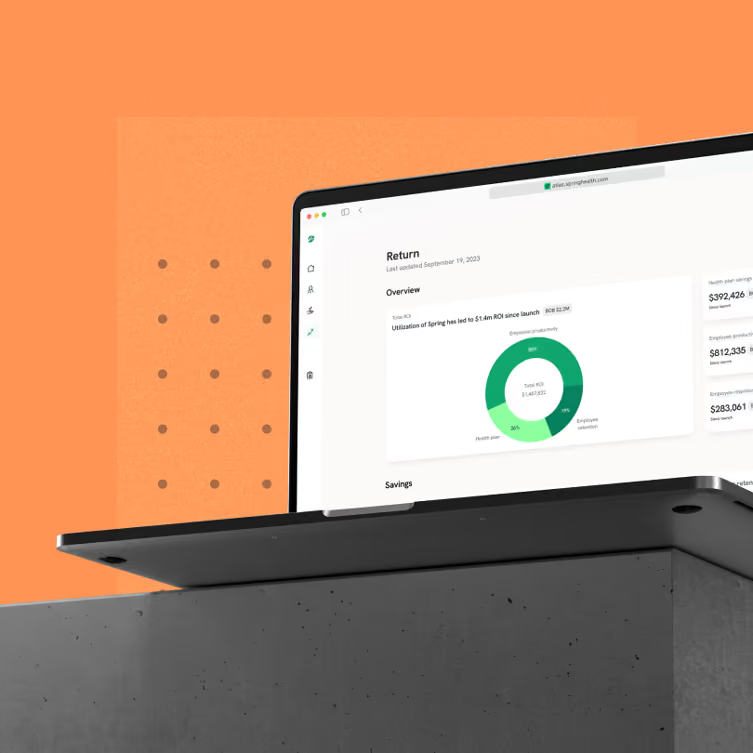
For benefits leaders, this is the business case. Mental health care should not sit outside the healthcare cost strategy. It should be one of the measurable ways employers manage that strategy.
What employers should do next
Employers cannot control every force driving healthcare inflation. They can control whether their mental health strategy is built to reduce avoidable spend.
Start with these questions:
- Are employees getting into care fast enough to prevent escalation?
- Does the benefit match people to the right care, or does it send everyone through the same pathway?
- Can you measure clinical outcomes, not just utilization?
- Can you connect mental health engagement to medical claims impact?
- Does your vendor report results in a way HR, finance, and the C-suite can use?
- Are you supporting mental health needs connected to chronic conditions, high-cost claims, leave, and pharmacy spend?
If the answer to those questions is unclear, the benefit may be helping some employees while leaving the larger cost opportunity untouched.
Employer healthcare costs are rising, but the response does not have to be limited to higher deductibles, narrower coverage, or more employee cost-sharing. A stronger mental health strategy gives employers another lever: treat needs earlier, guide employees to the right care, measure outcomes, and reduce avoidable spend across the health plan.
About Spring Health
Spring Health is a global mental health company built on one AI-native platform so care follows individuals across every job, move, health plan, and life stage. Independently validated by JAMA Network Open and the Validation Institute, Spring Health reaches 170+ million people worldwide through leading employers and health plans.
FAQ
Why are employer healthcare costs rising in 2026?
Employer healthcare costs are rising because several cost drivers are compounding at once: higher medical utilization, pharmacy spend, GLP-1 use, cancer care, chronic conditions, high-cost claimants, and increased use of mental health and substance use disorder services.
How do behavioral health costs affect employer healthcare spend?
Behavioral health costs affect employer healthcare spend directly through mental health and substance use disorder claims, and indirectly through medical utilization, chronic condition management, pharmacy adherence, leave, disability, absenteeism, and high-cost events.
Can mental health benefits reduce employer healthcare costs?
Yes, when the benefit is fast, clinically effective, and measurable. At Spring Health, employers see a 52% reduction in total mental health claims costs for employers and $1,796 lower healthcare costs per patient per year.
What should employers look for in a mental health solution?
Employers should look for:
- Fast access that produces lasting outcomes.
- Precise provider matching.
- Measurement-based care.
- Clear outcomes reporting.
- Claims integration.
- Proof that the benefit improves both clinical and financial outcomes.




.png)


.avif)
.avif)


.avif)

.avif)
.avif)
