

When employees log into work on time and show up to meetings, they don’t leave their stressors at the door.
Financial stress, caregiving responsibilities, anxiety over AI … they’re carrying that and more into your offices every day.
Mental health is no longer just a wellbeing conversation. It is a cost, risk, and performance conversation. Leading organizations are seeing the opportunity to lean on mental health benefits as more than just a benefit, but a meaningful way to drive down health plan spend.
The time is now to build a business case for mental health in the workplace.
Employee mental health is at a breaking point
Most HR leaders already know this intuitively. They feel it in:
- Rising burnout complaints
- Increasing disability and leave claims
- Managers who are exhausted themselves
- Employees who are disengaged but not absent
But the data makes the reality harder to ignore.
According to research conducted by Spring Health in early 2026, HR leaders estimate that 30% of employees are experiencing silent burnout, and 40% of burned-out employees say they experienced presenteeism (physically present but mentally checked out).
Additionally, 74% of employees said in a Spring Health survey that financial stress has impacted their mental health.
The “status quo tax” of underperforming mental health benefits
Many employers already offer an Employee Assistance Program (EAP). On paper, the box is checked.
But if utilization is low, engagement is uneven, and outcomes aren’t tracked, the organization is quietly paying what we call the status quo tax.
The status quo tax shows up in predictable ways:
1. Medical and pharmacy costs
When mental health conditions go untreated, they often escalate into higher-cost physical health claims. Depression, anxiety, and chronic stress can worsen comorbid conditions and increase emergency and inpatient utilization.
If organizations aren’t measuring the downstream impact of mental health on total medical spend, they’re likely absorbing hidden costs.
2. Leaves of absence and disability
Mental health leaves are often a late-stage indicator of strain. By the time someone goes out on leave, performance has already declined, workloads have been redistributed, and operational continuity has been disrupted.
3. Presenteeism and productivity drag
Presenteeism (being physically present but mentally checked out) is a sustained performance tax. It reduces output, increases errors, and creates friction across teams.
Silent burnout rarely appears on a balance sheet. But it absolutely affects the bottom line.
4. Talent and retention risk
Sixty-nine percent of employees said in Spring Health’s recent research that mental health benefits are very or extremely important when choosing a job.
If your strategy isn’t visible, accessible, and effective, you’re not just paying in claims. You’re paying in lost talent.
Why “checking the box” isn’t enough
Spring Health’s Mental Health Benefits Maturity Model outlines four stages of employer strategy:
- Checking the box (traditional EAP). Compliance-driven. Limited measurement. Low engagement. No clear ROI.
- Building (expanded EAP + digital tools). More access points, but engagement and outcomes remain inconsistent.
- Developing (integrated, measurable strategy). Evidence-based care with some outcome tracking.
- Leading (technology-enabled, precision mental health). High-quality, personalized care with real-time ROI tracking and year-over-year financial accountability .
The difference between checking the box and leading is measurable impact.
What a real business case looks like
If you’re building the business case internally, especially for finance leadership, your pitch must do more than appeal to empathy.
It must address four realities.
1. The status quo isn’t delivering measurable returns
Open with the truth:
- Employees aren’t consistently engaging.
- Leaves are increasing.
- Employee burnout persists.
- Health plan costs continue to rise.
The absence of measurement is not neutrality. It's a risk.
2. Upfront investment does not mean higher long-term cost
Yes, enhanced mental health solutions may require budget.
But staying with a low-engagement, low-impact model means continuing to spend without measurable returns.
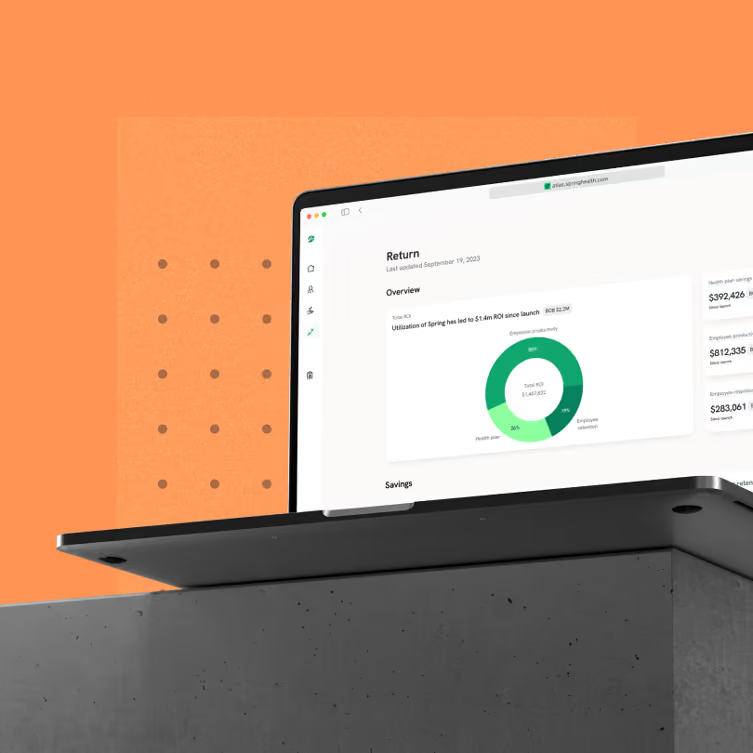
The most mature strategies demonstrate predictable ROI and health plan savings over time. And that ROI can happen as early as Year 1.
3. ROI must be net and defensible
ROI isn’t a vanity metric. It should include:
- Health plan savings
- Productivity gains
- The cost of the solution itself
Leading organizations are able (or have a solution) to track ROI year over year and align mental health metrics with quarterly and annual business reviews.
4. The people impact is the business impact
Mental health affects:
- Retention
- Productivity
- Engagement
- Workplace safety
- Manager effectiveness
This is not a soft issue. It’s a performance lever.
Mental health as a strategic lever
Mental health support is no longer a standalone wellbeing initiative.
It is:
- A talent strategy
- A cost containment strategy
- A risk mitigation strategy
- A credibility strategy
When employees are supported early, burnout decreases, leaves shorten, and health plan costs become more predictable.
When support is discoverable, accessible, and effective, utilization rises and investment becomes defensible.
And with the right solution, utilization increases deliver better employee outcomes and higher business results.
The business case for mental health in the workplace is not theoretical.
It’s measurable.




.png)


.avif)
.avif)


.avif)

.avif)
.avif)
