


HR and benefits leaders face a pair of unique challenges.
They’re supporting employees through burnout, financial stress, family pressures, global uncertainty, and rising mental health needs. At the same time, they’re asked to defend every investment, manage tighter budgets, and show how their benefits programs contribute to business performance.
That’s not easy, because some of HR’s most valuable work is preventative. It’s the resignation that didn’t happen. The leave that was avoided. The manager who got support before a team issue became a business issue. The employee who found care before stress turned into a crisis.
This work matters. But to secure budget and leadership support, HR has to make that value visible.
What are HR’s biggest challenges in 2026? And how can you address them with both support and business results?
HR’s biggest challenges in 2026
In early 2026, Spring Health asked HR and benefits professionals what keeps them up at night. This research informed our 2026 Workplace Mental Health Annual Report that was published last month. Their top answers were:
- Retaining top talent in a competitive market: 44%
- Pressure to demonstrate ROI on benefits programs: 38%
- Rising burnout and mental health challenges among employees: 37%
- Budget pressures impacting benefits decisions: 37%
- Increasing disability and leave of absence claims: 29%
- Lack of leadership buy-in for mental health investment: 28%
- Managing mental health needs across a diverse, global workforce: 22%
These are some distinct challenges, but for many of them, they’re intertwined. For example, demonstrating ROI will help secure leadership buy-in for benefits investment. Reducing burnout among employees should also help you retain employees.
Let’s explore each of these unique challenges and how the right mental health solution can impact each.
Breaking down HR’s unique challenges
#1: Retaining top talent in a competitive market
Why this matters
Nearly 7 in 10 organizations say it’s difficult to recruit for full-time openings. That’s meaningful when you consider how much time HR professionals spend on recruitment and retention. According to the U.S. Bureau of Labor Statistics, Americans stay with employers for an average of 3.9 years as of January 2024, which is the lowest number recorded since 2002.
On top of that, replacing an employee is a significant cost for employers when you factor in covering for the departing employee, finding a new one, and training that new one. Employee Benefit News estimates that losing an employee costs about one-third of that employee’s salary.
How a mental health solution helps
As mentioned in Spring Health’s 2026 Workplace Mental Health Annual Report, 69% of employees say mental health benefits are very or extremely important to their job decisions. For 18-to-34-year-olds and 35-to-44-year-olds, those numbers are even higher: 83% and 78%, respectively.
When employees have access to the right care before challenges escalate, they’re more likely to get better, stay better, and feel cared for. That, in turn, should encourage them to stay or want to be a part of your organization.
#2: Pressure to demonstrate ROI
Why this matters
Spring Health Chief People Officer Karishma Patel Buford once said, “You can’t just talk about it as, ‘We’re doing this for our people.’ You have to tie it back to the business.”
That’s where the ROI pressure becomes as much a finance exercise as it is a “do right for my people” exercise. But if you’re challenged to prove the ROI of your mental health solution, you’re not alone. Only 9% of HR professionals in our research said that their solution clearly dives down health plan spend.
How a mental health solution helps
The best mental health solutions can show more than just utilization rates. ROI should be an expectation when investing in mental health, and savings should clearly show up in the form of reduced health plan spend. And those savings should be independently verified so they have the credibility you and your finance leaders need when making that investment.
#3: Rising burnout and mental health challenges
Why this matters
Employee burnout isn’t always visible, and it can be hard to spot. At the same time, burnout can also be the overlooked driver of many challenges that do show up from a business perspective, such as employee turnover and leave-of-absence claims. Within our research, 61% of HR and benefits professionals said employee burnout had increased in the past year.
How a mental health solution helps
The right solution can help employers identify risk earlier and give employees a faster path to support, before higher-acuity needs emerge. Early assessments, one-to-one navigation, self-guided tools, and manager-specific mental health training are all critical tools in reducing burnout.
#4: Budget pressures impacting benefits decisions
Why this matters
Nearly 3 in 5 employers were planning to make cuts to their health benefits plans in 2026 in an effort to combat rising costs, according to research by Mercer. However, what might get overlooked in making proactive cuts is the downstream cost impact of pulling back on proactive support.
How a mental health solution helps
The right solution should make care easier to access while helping reduce downstream costs tied to untreated or undertreated mental health needs. Those costs can include:
- Medical claims
- Pharmacy spend
- Emergency room visits
- Absenteeism
- Presenteeism
- Employee turnover
- Disability claims
- Leaves of absence
When HR can connect mental health support to cost containment, the conversation shifts. The question becomes less about whether the organization can afford better mental health support and more about what untreated mental health needs are already costing the business. At that point, you are better equipped to secure budget.
#5: Increasing disability and LOA claims
Why this matters
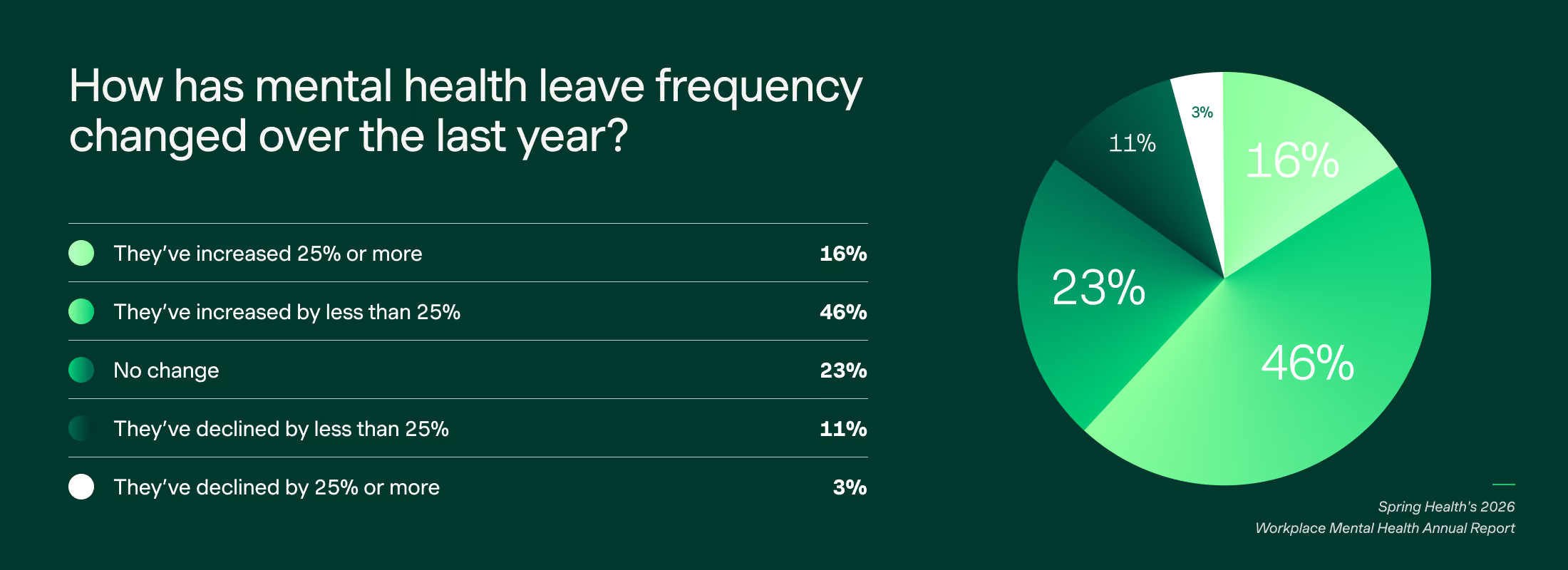
Our research also found that 61% of HR and benefits professionals say their mental health leaves have increased in the past year, with 16% of all respondents saying they’ve increased by 25% or more.
Leaves of absence provide organizational strain in a variety of ways. The employee on a leave of absence is clearly feeling the strain, but so are the managers and colleagues who are filling the void left by that employee. On top of that, if the employee doesn’t truly get better, then your organization could face repeat leaves or regrettable attrition.
How a mental health solution helps
The best mental health solutions can provide end-to-end support, including evaluations, documentations, personalized care plans, and return-to-work support. With Spring Health, that includes:
- Providers who are specially trained to deliver clear and effective documentation
- Smooth hand-offs of necessary paperwork to reduce administrative burden
- Assessment-to-treatment support of the employee with the ability triage higher-acuity needs for specialized providers.
#6: Lack of leadership buy-in for mental health investment
Why this matters
Business leaders have many priorities to juggle. While investing in a mental health solution might seem like a slam dunk, organizations have many needs. To make this need a priority, HR leaders need to clearly articulate the need, the potential ROI of the investment, and also the cost organizations are paying by not investing.
How a mental health solution helps
Modern mental health solutions can help HR leaders frame mental health as more than just “the right thing to do” by providing data on measurable impact, such as ROI, clinical outcomes, and productivity.
#7: Managing diverse, global mental health needs
Why this matters
Employee mental health needs can vary widely. A frontline worker may face different barriers to care than an employee who works at a desk. Employees with large families may have different needs than employees who live alone. And then there are different ages, races, cultures, genders, and income levels also coming together in the office, all of which influence top barriers to care and impact your utilization rates.
When mental health goes under-utilized, your employees aren’t reaping the benefits and your ability to build the business case for it becomes more challenging.
How a mental health solution can help
Modern solutions should be globally consistent and locally relevant. That means culturally responsive care, language access, diverse provider options, flexible care modalities, support for dependents and families, and reporting that helps HR understand which populations are engaging and which may be getting missed.
This is especially important for large employers with complex workforces. A strong mental health solution should help HR leaders manage centrally while still adapting to local needs, cultural differences, and population-specific barriers.
3 takeaways to address your biggest challenges
- Evaluate whether employees can actually find and start care. Ask whether employees know your current EAP or mental health solution exists, do they trust it, and can they start care without friction. If awareness is low, access is confusing, or appointments take weeks, the benefit may be failing before care even begins.
- Pressure-test whether your solution supports the full range of employee needs. Many programs work for low-acuity stress but fall short when employees need more specialized care, medication management, crisis support, family support, or help navigating leave. Evaluate whether your current solution can support employees across the full spectrum of need.
- Ask whether your current reporting can support a budget conversation. If your current solution can only show utilization, you may not have enough evidence to defend the investment. Look for solutions with reporting that connects mental health support to outcomes HR and finance care about.




.png)


.avif)
.avif)


.avif)

.avif)
.avif)
