.avif)
.avif)
.avif)
You have a presentation due to the benefits committee this week, and finance will be in the room.
Spend is up across the board, and finance is looking for places to cut. You have a folder of PDFs from across your benefits suite, including wellbeing solutions, EAPs, behavioral health plans, tobacco cessation programs, and onsite clinics. Each measures different metrics on different timelines. Utilization here, a satisfaction score there, a claims summary that does not quite line up with either.
You are stitching together a story by hand, and you keep checking the numbers because you are not sure they agree with each other, and you really do not want to be wrong in front of finance. The questions you will have to answer are simple:
- Is this working?
- Can you prove it is worth the spend?
It’s easy to assume the problem is the reporting. If the data was cleaner and consolidated into a single dashboard, everything would be fine. But the folder of PDFs is an indication of an underlying care challenge that is holding your organization back.
The reporting is a symptom, but not the disease
The reason the data comes to you fragmented is that the care underneath it is fragmented. And that same fragmentation is doing something far more expensive than ruining your slide. It is slowing down how fast your people actually recover. Your reporting problem and your cost problem are the same problem.
Mental health ROI comes down to this
Mental health ROI increases when people get the right care, get better faster, and stay better over time.
The reason is simple: Mental health does not exist separately from physical health. When someone is demonstrating symptoms of depression, anxiety, burnout, or another mental health condition, every other aspect of their health becomes harder to manage. Treatment plans are easier to abandon. Chronic conditions become harder to control. Medications are missed. Sleep, nutrition, and exercise often deteriorate.
When mental health improves, the opposite happens. People are more likely to:
- Follow treatment recommendations.
- Manage chronic conditions effectively.
- Take medications as prescribed.
- Engage in the behaviors that support long-term health.
That is why some of the largest financial returns from mental healthcare show up not in mental health claims, but in reduced physical healthcare spend.
The impact extends beyond healthcare costs. People spend less time in high-cost crises, miss fewer days of work, are more productive when they are at work, and are less likely to leave their jobs.
The value of a clinical approach you can depend on
To drive value and ROI, you need a clinical approach that organizations and members can count on to produce lasting outcomes.
Measurement-based care is a clinical approach that produces reliable outcomes in a few key ways, including:
- A single standard of care throughout a member’s care journey.
- Validated assessments at every step.
- Care plans adjusted dynamically based on member progress, symptoms, risk signals, and goals.
- All sessions and care touchpoints are tracked for providers in one single, AI-native platform.
On the flip side, when care is fragmented across different providers using different record systems, much of it happening off-platform, there is no consistent measurement and no real quality control. Care quality swings from provider to provider. There is no shared knowledge or care coordination across providers. The member easily slips through the cracks, assuming they find the point of entry to care to get started. Recovery slows.
That same scattered care produces scattered data. The inconsistency that slows recovery is the exact inconsistency that lands on your desk as a pile of PDFs that do not agree with each other. One root cause, two symptoms. The slow recovery is the one that costs you money. The bad report is just the one you can see.
It takes all three moving together
Consistency is not a setting you switch on. It holds only when three people behave differently, in a coordinated way, at the same time.
1) The member has to get to the right care fast, and stay in it
Most people either never start care, start the wrong kind of care, or drop out before it works. Spring Health changes that with precision-matching to the right provider and with Guide keeping people engaged between sessions so they do not fall off in the first few weeks, when most people do. More people start the right care, and more of them finish it. And as care continues, members can opt in to AI summaries and takeaways from their sessions, so nothing is lost from one appointment to the next, and they can work on skill building between sessions.
2) The provider has to be able to pick up exactly where the last one left off
Every Spring Health provider works in the same system, and AI note-taking captures each session consistently and in more detail than anyone would reliably write by hand. So context is never lost. A member can start in couples therapy, come back years later for individual grief counseling, and later see a medication manager for postpartum depression, and the thread holds across all of it.
Guide is there through the whole journey too, so the clinician walks into every session with the full picture instead of only what the member remembers to mention.
3) The employer needs to be able to move at the speed of business
Business priorities can change daily. Workforce risks shift quickly. Finance questions evolve. AI is only accelerating the pace at which leaders expect teams to act, measure, and adjust.
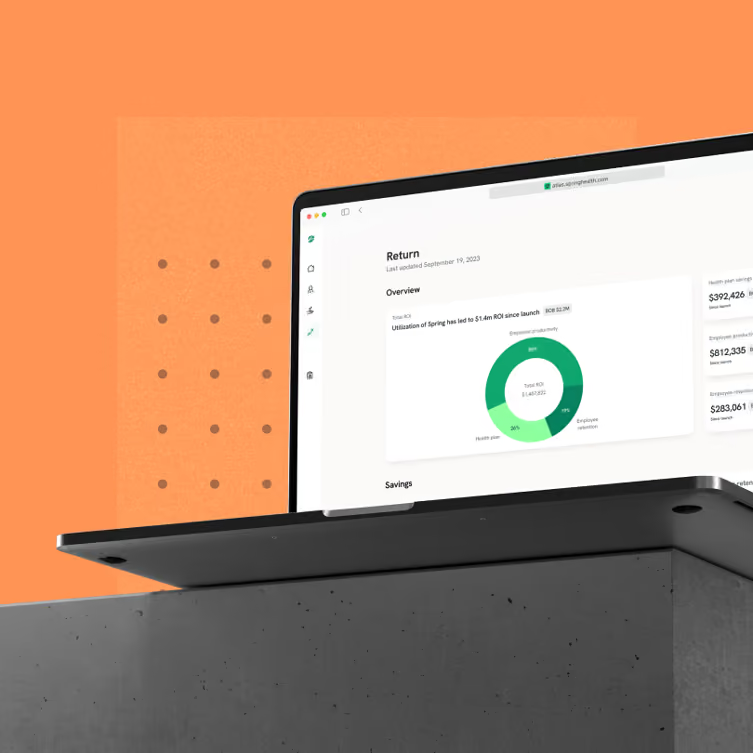
Benefits teams need the same ability. They cannot wait for a quarterly PDF to learn whether their mental health strategy is working. They need connected, real-time insight that helps them see where care is improving outcomes, where people are getting stuck, and where a change in strategy could make a difference now.
Spring Health uses AI to turn connected data into forward-looking insights, so employers can:
- Execute their strategy.
- Measure what changed.
- Adjust while there is still time to improve outcomes.
Instead of explaining a quarter that already ended, benefits leaders can make decisions in the same rhythm as the business.
Each of those alone is a feature. Together, they form a connected loop. The member gets to the right care and stays engaged. The provider has the full clinical context to guide care that works. The employer can see what is happening, act quickly, and measure whether that action improved results. Every turn of that loop helps people get better faster and stay better longer.
Why only an AI-native platform can do this
Consistent, measurable, connected care requires rich information across providers, members, and employers, all in one system, in real time. And that’s not something that can be built after the fact.
A point solution only ever sees its own slice. A vendor that built its network by stitching together third parties and separate record systems cannot hold the thread, because the care was never in one place to begin with. A traditional EAP still keeping paper notes cannot measure consistently at all. So none of them can connect what happened in a member's care to what a provider should do next, to what an employer needs to see. The data is fragmented because the care is fragmented.
Spring Health was built on one AI-native platform from the start, which is the only way the data is rich enough, connected enough, and fast enough to change behavior while it still matters. AI is what makes that consistency possible at scale: measurement on every member, notes on every session, insight across the whole population, in real time.
Faster recovery is faster ROI
Faster recovery shows up as clinical improvement, then as productivity, then as retention, then as lower claims cost.
Spring Health members recover 56% faster than other clinical models. 92% reliably improve or recover from depression or anxiety. People recover 0.7 days of productivity per week on average. Employees are 60% less likely to leave. And employers spend $1,070 less per person per year in healthcare costs.
Consistent care that works produces all of these results at once. And because that recovery is real and measured, Spring Health can do something a fragmented vendor cannot. We guarantee net ROI, and it climbs every year you stay:
- 1x in year one
- 1.5x in year two
- 2x in year three
The benefit pays for itself, and then it pays you back. And we will prove it on your own population, using the same peer-reviewed methodology behind our published work.
You do not guarantee what you can only describe. You guarantee what the engine lets you predict.
The line between a cost center and an investment
The benefits leader who walks into that meeting with a folder of mismatched PDFs has a cost to defend. The one who can show that people are recovering faster, that recovery is what is lowering spend, and that the platform lets them see it and steer it in real time has already made the case.
That is the shift, and it was never really about the report. The report was only ever a symptom. ROI in mental health is the output of an AI-native platform consistent enough to get people better, faster, and connected enough to prove it.
Activity tells you something happened. This tells you it worked, and why, and what to do next.




.png)


.avif)
.avif)


.avif)

.avif)
.avif)
