


Employee engagement isn't just a "feel-good" metric. It’s a financial differentiator for leading companies.
Gallup has found that managers account for up to 70% of the variance in team engagement, and the stakes couldn't be higher. An estimated $9.6 trillion in productivity could be added to the global economy if the workforce were fully engaged.
However, a significant, invisible friction point is holding organizations back: Gender gaps in mental health.
True mental health equity is "the principle of ensuring fair access to mental health services for all people, regardless of race, gender, income, or geography. Mental health equity emphasizes removing barriers and addressing systemic disparities."
But as our 2026 benchmarking research reveals, men and women are currently navigating two very different, and very costly, versions of the workplace.
For women, it's heightened burnout and the cost of care
In 2026, Spring Health surveyed 1,500+ full-time employees across five countries, and the results revealed a number of interesting findings when it comes to gender gaps in workplace mental health. For example, our research shows that women are 17% more likely than men to be currently experiencing burnout.
This isn't just a matter of workload; it’s a matter of access. GoodRx found that women spend over 50% more out-of-pocket on mental health medications than men, totaling over $1.8 billion in additional spending per year. That might partly explains why women in Spring Health's research were 7% more likely than men to cite cost as a primary barrier to seeking support.
A couple more areas to call out:
- The AI friction point: As AI reshapes the workplace, a new psychological barrier has emerged. Within Spring Health's research, men were 31% more likely than women to feel "more or extremely secure" about AI’s impact on their jobs. For women, this lower sense of security (34.8% versus 45.7% for men) creates a significant source of "future-of-work" anxiety that requires tailored support.
- The caregiving factor: Unpaid caregiving, which is estimated to account for up to 9% of global GDP, disproportionately falls on women. Within Spring Health's research, women were 23% more likely than men to prioritize evening and weekend appointments to balance care and work.
For men, it's trust, friction, and deal-breakers
While women were more likely to cite cost of care as a challenge, men were frequently challenged by the system of care. Within Spring Health's research, men were 12% more likely to say mental health benefits are a “deal-breaker” for their job decisions, yet there are certain hurdles they’re more likely to face:
- System friction: Men were 32% more likely to say they felt confused about how to access care and 28% more likely to cite privacy concerns as a barrier to seeking support.
- Manager resistance: Men were 42% more likely to feel held back by manager resistance or discomfort.
Bridging the gender gap: 5 strategies for mental health equity
To preserve productivity and foster a culture where everyone thrives, organizations must move beyond equality (equal care for everyone) to equity (care tailored to unique needs).
1. Ask, analyze, and repeat
You cannot fix what you do not measure. Use a platform that turns engagement and outcomes data into actionable insights. Slice your internal survey results by gender to understand how each group feels and where they are getting "stuck" in your benefits funnel.
2. Nurture your leaders
Managers must be equipped to handle diverse needs. Despite their influence, just 44% of the world’s managers say they have received management training. Mental health training for managers is a non-negotiable today, and providing them with the tools to build psychological safety is the fastest way to reduce the "manager resistance" barrier for men.
3. Provide precision-based care
"One size fits all" isn't just a recipe for low utilization. It's a recipe for escalating costs. Precision mental health shifts the focus from simply offering a benefit to ensuring care actually resolves issues early and effectively. This model is built on better matching, routing employees to the appropriate level of support from the start to reduce wasted time, unnecessary sessions, and the high-cost medical claims that occur when care is delayed.
4. Support caregivers through flexibility
Flexible work is a cornerstone of equity. Whether it's schedules, locations, or meeting availability, flexibility allows the 1 in 6 employees who are caregivers to integrate wellness into their workday without sacrificing their careers.
5. Address the social determinants of health (SDOH)
Environmental factors, such as where people live, work, and age, impact their mental health. Organizations can bolster equity by offering financial coaching, emergency relief, and 401(k) contributions to elevate equity and ensure across the organization.
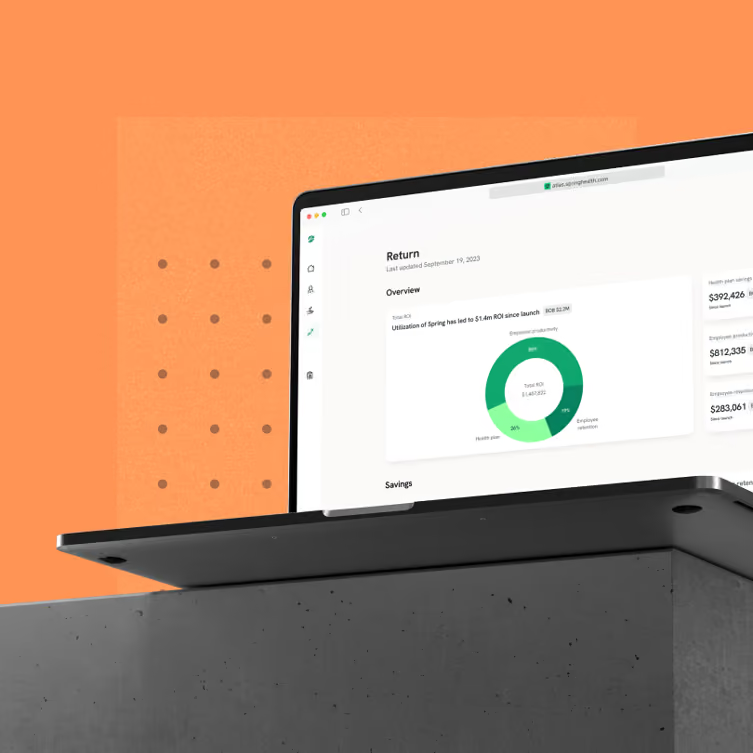
The bottom line: Closing the gender gap puts ROI in action
Closing the gender gap isn't just the right thing to do; it’s a proven driver of value in your mental health investment.
When you dismantle the barriers unique to each gender, you don't just improve lives—you unlock the full potential of your organization.




.png)


.avif)
.avif)

.avif)

.avif)
.avif)
